Time it takes: 20 minutes, once a month. A monthly budget review is the one money habit that keeps every other one honest. Skip it for a few months and the budget on paper and the money in the account quietly stop describing the same life. Do it once a month and the budget stays true, because you keep correcting it while the corrections are still small.
Quick answer: how do you do a monthly budget review?
Once a month, sit down with last month’s budget and last month’s statements and compare what you planned with what happened in four passes: income, fixed costs, flexible spending and goals. Write down what you learn, then change one thing for next month. Twenty minutes, one change, every month.
If you would rather have the four passes already laid out on paper, the Ultimate Budget Binder has a page for each one: a monthly budget sheet with planned and actual columns side by side, a bill calendar, an expense tracker and a savings thermometer. It is printable and fillable, so it works on a desk or on a tablet.
Jump Ahead To:
What is a monthly budget review?
Sense here, and this one is my favorite twenty minutes of the month. A monthly budget review is a short, scheduled sit-down where you compare the budget you wrote at the start of the month with what the month did. You are not building a new budget and you are not judging the old one. You are closing the month: finding the gaps, naming the reasons, and carrying one lesson forward.
The founder of this shop spent close to thirty years as a company CFO, and in that world the month does not end when the calendar flips. It ends when someone closes the books: every account reconciled, every surprise explained, one page of notes for next month. Companies do it because a plan nobody checks is just a wish with columns. A monthly budget review is the same close, for one person’s money, with a lot less paperwork.
Why does a budget stop being true after a few months?
A budget is a forecast. You wrote it with the information you had on the day you wrote it, and the world kept moving. The phone plan went up a few dollars. The gym you meant to cancel renewed. Groceries drifted. A new subscription appeared and felt small. None of them was visible on the day the budget was written.
Left alone, those small drifts compound. By month three the numbers on the page are history and the account balance is reality, and the gap between them is what makes budgeting feel pointless. “I have a budget, I just never look at it” is the most common sentence I hear, and it is not a character flaw. It is a missing step. The review is the step.
How do you review a monthly budget in four passes?
Gather three things before you start: last month’s budget, last month’s bank and card statements (the app is fine), and something to write on. Then work through the four passes in order. Each one answers a single question, and each has a page in the binder that holds it.
- The income pass: what actually came in? Add up every deposit that landed last month and write it next to the income you planned. Most months they match. The months they do not are the ones worth a note: a third paycheck, a bonus, a short week, a client who paid late. If your income moves around from month to month, this pass is where the whole review earns its keep, and our guide to irregular income budgeting shows how to plan around the low months instead of the average. Binder page: the income section at the top of the monthly budget sheet, with its planned and actual columns.
- The fixed pass: did every bill land where you expected? Run down the fixed costs, rent or mortgage, utilities, insurance, loan payments, subscriptions, and check two things for each: it was paid, and it was the amount you planned. This is where you catch the quiet increases and the subscription you forgot you had. Anything that comes once or twice a year instead of monthly gets flagged for the goals pass. Binder pages: the monthly bill payment calendar and the fixed expenses rows on the budget sheet.
- The flexible pass: where did the rest go? Groceries, gas, eating out, clothes, the “misc” line that is never as small as it looks. Compare planned against actual for each category and circle the biggest gap, up or down. Do not try to explain every dollar; find the one category that moved the most and write one sentence about why. That sentence is usually the whole lesson of the month. Binder pages: the variable expenses section of the budget sheet and the daily expense tracker, if you kept one.
- The goals pass: did the money for later actually get there? Check the transfers to savings, the extra toward debt and the deposits into any sinking funds. Planned versus actual, same as the rest. If a goal got skipped because the flexible pass ran over, that is not a verdict, it is a connection, and now you can see it. Binder pages: the savings and debt thermometer, the debt worksheet and the net worth worksheet, which you update once a month right here.
Four passes, four questions, four pages. When you reach the end you know exactly where last month went and why.
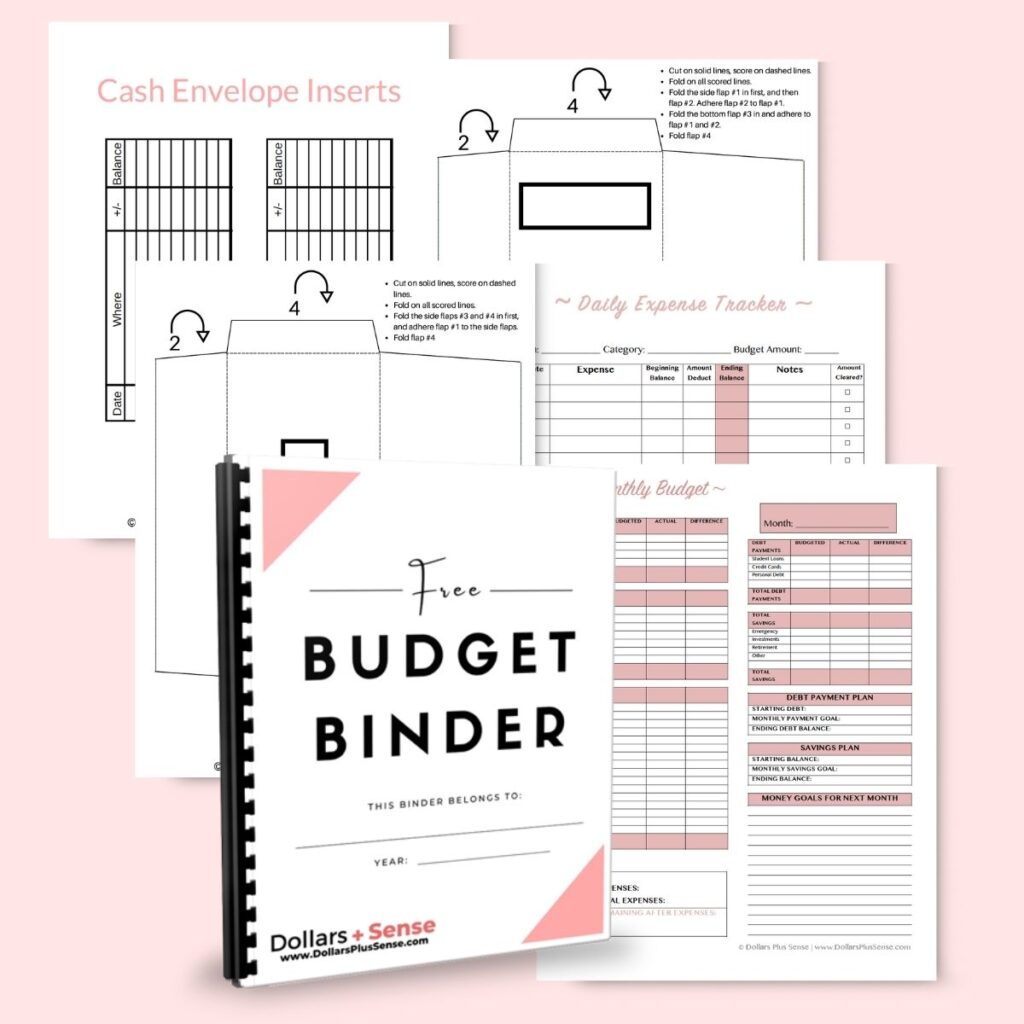
Want to try the passes before buying anything? The free budget binder has a basic monthly budget sheet with planned and actual columns. It is free with your email address, and it is enough to run your first review this month.
What does the review look like on paper?
This is the part a ready-made tool makes easy. Here is the set of pages inside the Ultimate Budget Binder, and you can see the four passes in it: the monthly budget sheet in the middle with its planned, actual and difference columns, the bill payment calendar and annual bill checklist for the fixed pass, the daily expense tracker for the flexible pass, and the thermometer, debt worksheet and net worth worksheet for the goals pass.

The difference column is the one to watch. Planned minus actual, one line per category, is the whole review in a single number per row. A row that reads close to zero is a category you understand. A row with a big number, in either direction, is the one that gets a sentence in your notes. The Ultimate Budget Binder gives you that column already drawn, twelve times a year, plus a small box at the bottom of the sheet for next month’s goals. That box is where the next section lives.
Why change only one thing for next month?
Here is the rule that makes the review stick: at the end of the twenty minutes, you change one thing. Not five. One.
Savvy would say, and she is not wrong, that after a review you can see six things you want to fix at once. Raise the grocery line, cancel the subscription, move the savings transfer to payday, start a sinking fund for the car, track eating out daily, and look at the phone plan. Every one of those is a good idea. Doing all six in one month is how a budget review turns into a budget overhaul, and overhauls are what people quit.
So you pick the one with the biggest gap from the flexible pass, or the one that cost a goal in the goals pass, and you write it in the goals box: “Grocery line up by what it actually cost, and a weekly cap.” Then next month’s review tells you whether it worked. One change a month is twelve real improvements a year, each one tested before the next one starts. Small steps add up, and they add up faster when you can see them working.
Two kinds of change tend to come up again and again. If the gap is a bill that only arrives a few times a year, the fix is a sinking fund budget, which sets a little aside every month so the bill stops being a surprise. If the gap is a whole month that was tighter than the others, the fix is usually visible in a yearly budget, where the heavy months show up in advance.
When should you do your monthly budget review?
The first few days of the new month, once the last statement of the old month has settled. Pick a day you can keep, put it on the calendar as a standing date with yourself, and treat it like one.
A few things make it easier to keep:
- Tie it to something that already happens. The first Sunday, the morning after the first paycheck, the day you pay rent. A review attached to a habit you already have is far more likely to survive a busy month.
- Set a timer. Twenty minutes is a limit, not a minimum. If you are still working at thirty, you have slipped from reviewing into rebuilding, and rebuilding is a different day’s job.
- End on the one change. Writing the change down is what makes the review feel finished. Do not close the binder without it.
If a month gets away from you and the review does not happen, do the next one. Two months of statements take thirty minutes instead of twenty, and the budget is still far truer than one that was never reviewed at all.
Frequently asked questions about monthly budget reviews
How long should a monthly budget review take?
About twenty minutes once the pages and statements are in front of you. The first one may run longer because you are learning the passes and finding your numbers. By the third month it gets quick, because most lines match and you are only writing notes on the few that moved.
What if I overspent in every category?
Then the budget was written for a different month than the one you had, which is useful to know. Do the four passes anyway, find the category with the biggest gap, and make that your one change. Often the fix is not spending less but planning what you actually spend, so the next review has something true to compare against. A budget that matches real life is the starting point, not the finish line.
Should I review my budget weekly or monthly?
Monthly is the review; weekly is a check-in. A five-minute weekly glance at the flexible categories keeps the month from getting away from you, but the four passes and the one change belong to the monthly sit-down, because that is when the income, the bills and the goals are all complete and can be compared fairly.
What should I keep from month to month?
Keep each month’s budget sheet with its actual column filled in, and the one-change note. That is your record. After a year you will have twelve sheets that show exactly how your money behaves across the seasons, which is the best possible starting material for next year’s budget.
Do I need a binder, or can I do this in a spreadsheet?
Either one works, and the four passes are the same in both. Paper suits you if you think with a pen and like seeing the month in one place; a spreadsheet suits you if you want the difference column to do its own math. The one that works is the one you will open on review day. Everything in this stage of the shop comes in a printable and fillable format for that reason.
Ready for your first review? The Ultimate Budget Binder ($12)
Eighteen pages that hold all four passes: the monthly budget sheet with planned, actual and difference columns, a bill payment calendar, an annual bill checklist, a daily expense tracker, a debt worksheet, a net worth worksheet and a savings thermometer, plus a short user guide. Print it, type into the fillable PDF, or write on it in a note-taking app. Reprint any page as often as you need it.
Already past the first review and working on debt as well? The Balancer Door bundles the binder with the budget and debt payoff files for the getting-a-grip stage, in one download.
A monthly budget review is not a test you pass or fail. It is twenty minutes of looking honestly at what happened, so next month’s plan is a little truer than this one. Four passes, one change, the same day every month. And if the only thing you do today is put that date on the calendar, the monthly budget sheet in the free budget binder will be waiting when the day comes.
General education, not investment advice.