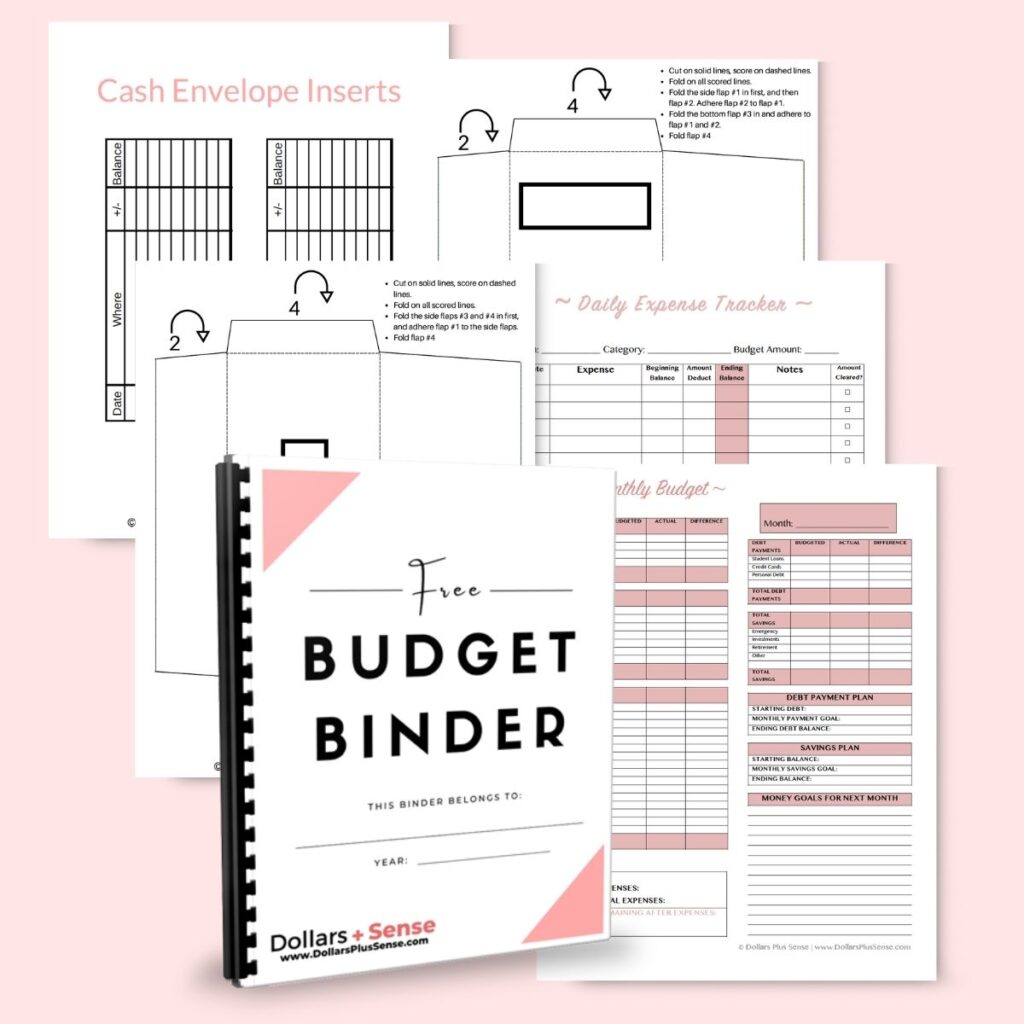
Time to set it up: about 15 minutes, before day 1. A monthly savings challenge is one of the few money moves you can start and finish on a single calendar page. The setup you do before it starts is what decides whether you are still checking off boxes in week three.
Quick answer: how do you run a monthly savings challenge you finish?
Pick one month, one rule and one tracker you will see every day. Before day 1, decide where the money goes and what you will do the day after you miss one. A challenge with a destination, a visible tracker and a plan for the miss is the kind that reaches the last box.
If you would like the rule, the tracker and the envelope already made, the 31-Day Savings Challenge is a one-page tracker that counts down from $31 to $1 and lands on $496 by the end of the month. It comes as a printable, a fillable PDF and a phone app for one price.
Jump Ahead To:
What is a monthly savings challenge?
A monthly savings challenge is a short game with one rule. For one calendar month you follow a simple saving rule every day and mark each day on a tracker. The rule can be a set dollar amount, your spare change, or a pause on non-essential spending.
The month is what makes it work. “Save more” has no finish line, so there is never a day you get to say you did it. A challenge has a day 1, a last day and a total, which makes it far easier to start than an open-ended promise.
Why do most savings challenges stall in week two?
Sense here, and let’s look at what really happens. When a challenge stalls, it is almost never about willpower. It is about how the challenge was set up. Three setup gaps do most of the damage:
- The rule is too big for the month it landed in. A rule you picked on an optimistic Sunday meets rent week, and the numbers do not fit. That is a sizing problem, and sizing can be fixed before you start.
- The tracker is hidden. It lives in a notes app, a closed notebook or a download folder. If you do not see it, a skipped day goes by quietly, and then so does the next one.
- The money has no destination. It sits in checking next to the grocery money, looking exactly like grocery money. By the 20th it has been spent on something perfectly reasonable, and the challenge feels pointless.
Notice what is not on that list: you. Each of those is a design choice, and you can make all three of them in the next 15 minutes.
How do you set up a savings challenge you will finish?
Work through these four steps before day 1. The founder of this shop spent close to thirty years as a company CFO, and in that world a plan that only works when nothing goes wrong is not called a plan. Step four is the one most challenges leave out.
- Choose the rule that fits your pay cycle. Look at where your paydays land in the month before you pick. A countdown rule, where the amounts start high and shrink, fits best when day 1 sits on or just after a payday, because the biggest deposits happen while the account is fullest. If the full amounts will not fit this month, cut every amount in half and run it at half size. A challenge you finish at half size still ends with real money and a full tracker. If your income changes from month to month, size the rule to your realistic low month; our guide to irregular income budgeting shows how to find that number.
- Name the destination. Decide two things: where the money physically goes (a separate savings account, a jar, a cash envelope) and what it is for (the first piece of an emergency cushion, December, the car insurance renewal). Money with a job is much harder to quietly borrow back. If the job is a bill that only comes once or twice a year, your sinking fund budget already has a line waiting for it.
- Put the tracker where you see it every day. The fridge, the bathroom mirror, the inside cover of your planner, or your phone’s home screen. Checking off the box is the small daily win that carries you through the middle of the month, so make it impossible to walk past.
- Plan the miss. You will probably miss a day. Almost everyone does. Decide now what happens next, and write it at the top of the tracker. A good rule is short: “The day after a miss, I do today’s amount and keep going.” Or: “Missed days get added to the end.” Either one works. What matters is that the decision is already made, so one empty box stays one empty box.
That is the whole setup: a rule, a destination, a visible tracker and a plan for the miss.
Need somewhere to write down step two? The free budget binder includes a savings goal sheet: one goal, with the math done once. It is free with your email address, and it pairs well with any challenge.
What does a savings challenge tracker look like?
Step three is where a ready-made tool does the work for you. Here is the tracker page from the 31-Day Savings Challenge.
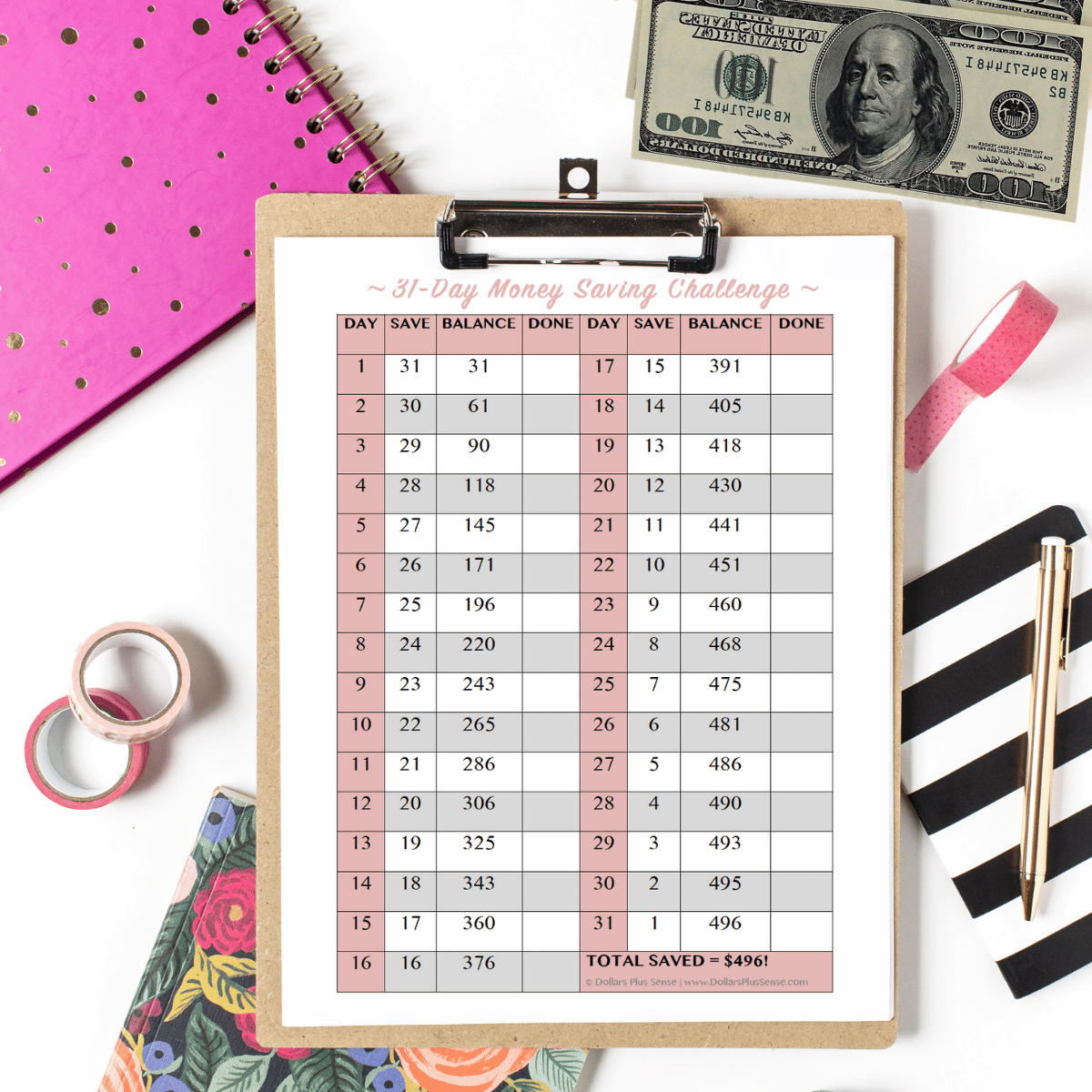
Each row has four things: the day, the amount to set aside, the running balance, and a box to check off. The amounts count down. Day 1 is $31, day 2 is $30, and the last day of the month is $1.
That order is deliberate. By the end of the first week you have already set aside $196, while your motivation is at its highest. The whole final week adds just $28. The month gets easier as it goes, which is the opposite of how most challenges feel. The 31-Day Savings Challenge also includes two printable cash envelopes, so the destination from step two is handled as well.
Which kind of savings challenge fits you?
There are three common kinds. None of them is the “serious” one. The right one is the one that fits the month you are actually having.
| Kind of challenge | The rule | A good fit if | Ready-made version |
|---|---|---|---|
| Daily amount | Set aside a specific amount each day, and know the total before you start. | Your paycheck is steady and you want a clear finish-line number. | 31-Day Savings Challenge ($4) |
| Spare change | Each day, drop your loose change into one savings spot and check off the day. | The budget is tight right now, or you want a first win that barely touches your bills. | 30-Day Spare Change Challenge ($4) |
| No-spend | Essentials only for 30 days. You write your own rules, and what you did not spend is the savings. | Your income covers the month, but money slips out in small purchases that are hard to trace afterward. | 30-Day No-Spend Challenge ($4) |
Savvy would add one thing here, and she is right: pick one. Running two challenges at once splits your attention and doubles the boxes. Finish this one, enjoy the total, and try a different kind next month if you are curious.
What do you do on day 32?
Day 32 is where a one-month challenge can turn into a habit. Three small moves get it there.
Move the money to its job. If you saved in cash, deposit it. If it is already in a separate account, label it for the purpose you named in step two. That last step is what turns a full tracker into money with a job.
Keep one piece of it running. You have just run a month-long experiment on your own budget, and you now know something you did not know on day 1: how much you can set aside without the month falling apart. Pick an amount at or below that, and set it up as an automatic transfer on payday. No tracker needed. The challenge found the number, and the transfer keeps it going.
Put the next one on the calendar. Not next month, unless you want to. Look across the year for a month with some room in it. If you have built a yearly budget, the comfortable months are already visible, and one of them is a good home for your next round.
Then take a minute to enjoy it. You set a rule and kept it for a month. That deserves a moment, whatever the total.
Frequently asked questions about monthly savings challenges
What is the best month to start a savings challenge?
The next one that starts on or near a payday. January is popular, but there is nothing special about it. A 31-day challenge fits a 31-day month neatly, and in a shorter month you can simply start a day or two early. If one month of your year is already heavy, such as December, choose the month before or after it.
What if I miss a day?
Follow the rule you wrote in step four. The simplest version is to do today’s amount and keep going. You can add the missed day to the end of the month if you want the full total, but you do not have to. A tracker with one empty box and thirty checked ones is a finished challenge.
Can I do a savings challenge with a partner or a friend?
Yes, and it helps. Each person keeps their own tracker and their own destination, and you agree on one check-in day a week. Compare checked boxes, not balances. The two of you may be saving different amounts, and the boxes are what you have in common.
Is a small amount worth saving?
Yes. The first thing a challenge builds is the habit of setting money aside on purpose, and that habit is the same size whether the daily amount is large or small. A small challenge you finish gives you a starting balance and a month of proof that you can do it. Small steps add up.
Should I save in cash or move the money in my banking app?
Use whichever one you will see. Cash in an envelope is visible and satisfying to watch grow. A transfer to a separate savings account takes a few seconds and keeps the money out of your wallet. If you choose cash, deposit it on day 32 so it gets to its job.
Ready for day 1? The 31-Day Savings Challenge ($4)
A one-page tracker that counts down from $31 to $1 and ends at $496, two printable cash envelopes for the money, and short instructions. Print it, type into the fillable PDF, or open the app on your phone and let it keep your running total and your streak. One price, all three formats.
Want a different rule? The Spare Change and No-Spend challenges are in the table above, and everything else for this stage is in the Getting a grip door.
A savings challenge does not need a perfect month. It needs a rule that fits, a place for the money to go, a tracker you can see and a plan for the day you miss. Set those four up before day 1 and the last box is a lot closer than it looks. And if all you do today is write down what the money is for, the savings goal sheet in the free budget binder is a good place to put it.
General education, not investment advice.